Spring's Gentle Pollinators: Identifying and Supporting Mason Bees

Mason bees play a quiet but vital role in Middle Tennessee gardens and natural spaces. These native pollinators are efficient, gentle, and easy to spot once you know what to look for. For gardeners interested in supporting local ecosystems, understanding mason bees can open the door to better plant health and a more vibrant garden. This article covers how to identify mason bees, their habits, and practical ways to encourage their presence in Middle Tennessee.

How to Identify Mason Bees
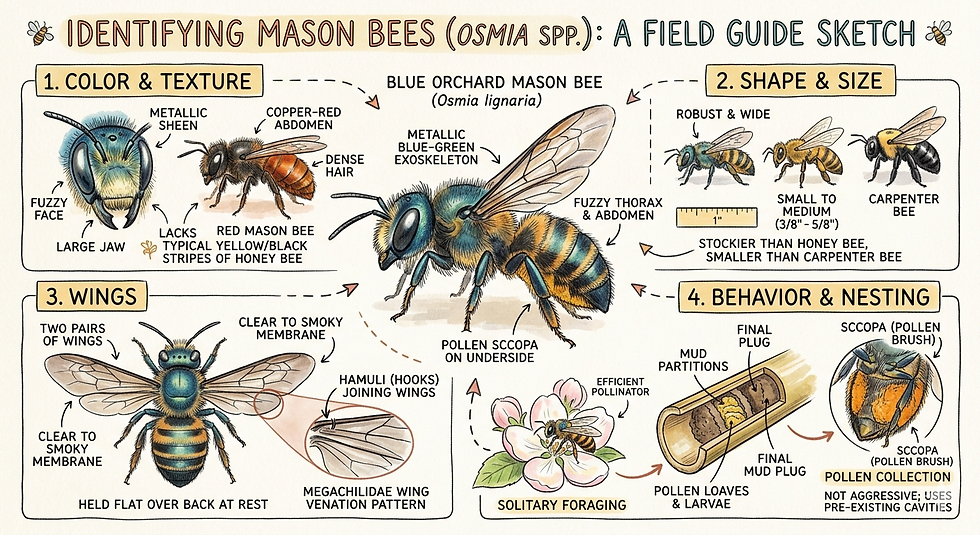
Mason bees are small, about the size of a honeybee but with a few distinct features:
Color and Texture: They have a metallic blue-green or black body covered with fine hairs, especially on the underside, which helps carry pollen.
Shape: Their bodies are more robust and less slender than honeybees.
Wings: Their wings are clear with a slight iridescence.
Behavior: Unlike honeybees, mason bees do not form large colonies or produce honey. They are solitary and often seen alone or in small groups.
In Middle Tennessee, you might notice mason bees visiting early spring blossoms such as fruit trees, willows, and native wildflowers. Their flight is slower and more deliberate compared to other bees.
Habitat and Range in Middle Tennessee
Mason bees thrive in temperate climates and are well adapted to the environment of Middle Tennessee. They prefer:
Nesting Sites: Hollow stems, holes in wood, or man-made bee houses.
Nearby Food Sources: Gardens, orchards, and wildflower patches.
Shelter: Areas protected from heavy rain and strong winds.
Their range covers much of Tennessee, but they are especially common in suburban and rural areas where native plants are abundant. Mason bees are active in early spring, often before honeybees become busy.
Seasonal Behavior of Mason Bees
Mason bees have a unique life cycle tied closely to the seasons:
Spring: Adults emerge from cocoons and begin foraging for pollen and nectar. This is their main active period.
Summer: Females build nests by gathering mud to partition individual brood cells inside tunnels.
Late Summer to Fall: Eggs hatch, larvae develop inside the sealed cells, and then enter a dormant stage.
Winter: Larvae remain in their cells, protected from cold, until the next spring.
This seasonal rhythm means mason bees are most visible and active during early spring, making that the best time to observe and support them.
Diet and Foraging Habits
Mason bees are excellent pollinators because they visit a wide variety of flowers. Their diet consists of:
Pollen: The primary protein source for their larvae.
Nectar: Provides energy for adult bees.
They prefer native flowering plants and fruit trees common in Middle Tennessee, such as:
Crab apple and cherry blossoms
Wild violets
Redbud trees
Serviceberry
Mason bees carry pollen on their hairy undersides rather than on their legs, which helps spread pollen more effectively between flowers.
Nesting and Raising Young in Middle Tennessee
Female mason bees are the architects of their nests. They look for narrow tunnels in wood or hollow stems, then:
Collect mud to create partitions between brood cells.
Lay a single egg in each cell.
Provide a pollen and nectar mix as food for the developing larva.
Seal the cell with mud before moving on to the next.
Gardeners can find mason bees nesting in natural cavities or in bee houses designed to mimic these conditions. The larvae develop inside the sealed cells through summer and fall, emerging as adults the following spring.
How Native Gardeners Can Support Mason Bees
Supporting mason bees is straightforward and rewarding. Here are some practical steps:
Provide Nesting Sites: Install bee houses with tubes or blocks of wood with holes 3/16" to 5/16" wide.
Plant Native Flowers: Include early-blooming plants like Eastern Red Columbine, Violets, and Virginia Bluebells to support early emerging females. Purple Coneflower, Black-eyed Susan, Milkweed, and Mountain Mint provide essential pollen and nectar during late spring and summer.
Avoid Pesticides: Use organic gardening methods to protect bees from harmful chemicals.
Leave Some Bare Soil or Mud Patches: Mason bees use mud for nest building.
Maintain Habitat Diversity: Include shrubs, trees, and ground cover to support a healthy ecosystem.
By creating a welcoming environment, gardeners can increase mason bee populations and improve pollination in their gardens.
How to Observe Mason Bees
Watching mason bees can be a peaceful and educational experience. To get the most out of your observations:
Visit your garden or local green spaces in early spring.
Look for solitary bees visiting flowers or entering small holes.
Use a magnifying glass to see their fine hairs and metallic coloring.
Avoid disturbing nests or handling bees, as they are gentle but best left undisturbed.
Record your sightings to track their activity and help local conservation efforts.
Ultimately, observing mason bees helps gardeners connect with nature and understand the important role these pollinators play in a healthy ecosystem.
You can now make a small donation to support the production of these blogs and videos, as well as to support the creation and maintenance of shortmeadow sanctuary. All donations make such a big difference! https://buymeacoffee.com/shortmeadow37206.

Comments